Industry expertise / Logistics & Fleet

Custom Logistics Software for Shipment and Fleet Workflows

Connect shipment paperwork, material allocation and dispatch coordination without forcing your operations into disconnected spreadsheets.

  • Produce consistent shipment and load documents
  • Explore bundle allocation and vehicle-loading checks
  • Keep dispatch status understandable for operations teams

Concept diagram · Not a client system screenshot

Operational problems

Where teams lose time and visibility

Explore two concrete workflow challenges and how software can address them.

01Shipment paperwork

Shipment documents are recreated across tools

Bills of Lading, loading records and labels may need to reference the same job data, but manual copying raises the chance of mismatches.

HOW WE APPROACH IT

Use job-linked document generation and controlled templates for consistent outbound paperwork.

  • Job-related Bills of Lading and labels
  • Reusable item and shipment references
  • Recipients and document distribution

Discuss this problem
02Vehicle allocation and verification

Loading teams lack a shared vehicle-wise view

A job may involve several deliveries and vehicles, leaving dispatch teams to reconcile bundles and completed loading steps manually.

HOW WE APPROACH IT

Plan an allocation and verification workflow that assigns bundle tags to loads and records loading checks; this is a proposed extension, not verified as deployed.

  • Vehicle-specific planned loads
  • Bundle tag allocation and split handling
  • Optional QR or manual loading confirmation
Discuss this problem
Solution capabilities

Practical systems aligned with real workflows

Start with the most pressing challenge and add integrations where they provide lasting value.

Shipment documents

Generate structured load paperwork from validated source data.

Material traceability

Model tagged inventory and item allocations to jobs and loads.

Dispatch planning

Organize multiple vehicles and handoffs through defined stages.

Loading verification

Design scan or manual confirmation steps for dispatch teams.

Workflow example / Illustrative visuals

Shipment paperwork and vehicle-loading coordination

A practical case-based scenario grounded in documented job-document work and extended with explicitly proposed vehicle allocation and loading checks. Illustrative screens are not client screenshots.

Illustrative workflow
THE CHALLENGE

Repeated paperwork and fragmented load assignment make coordinating job dispatches more difficult.

TECHNICAL APPROACH

Reuse structured job records for documents; design a second-stage vehicle loading module with explicit assignment and verification rules.

SOLUTION AREAS
  • Job and shipment references
  • Bill of Lading, labels and manifests
  • Vehicle allocation concept
  • Loading verification design
Outcome & Business Impact
  • Document consistencyStructured documents can reuse the same underlying job information.
  • Clearer shipment handoffConnected outputs help teams coordinate what paperwork is required.
  • Allocation visibility (proposed)Vehicle-level loading plans could support multi-vehicle jobs.
View all business benefits

Inside the workflow

Explore visuals related to the described workflow.

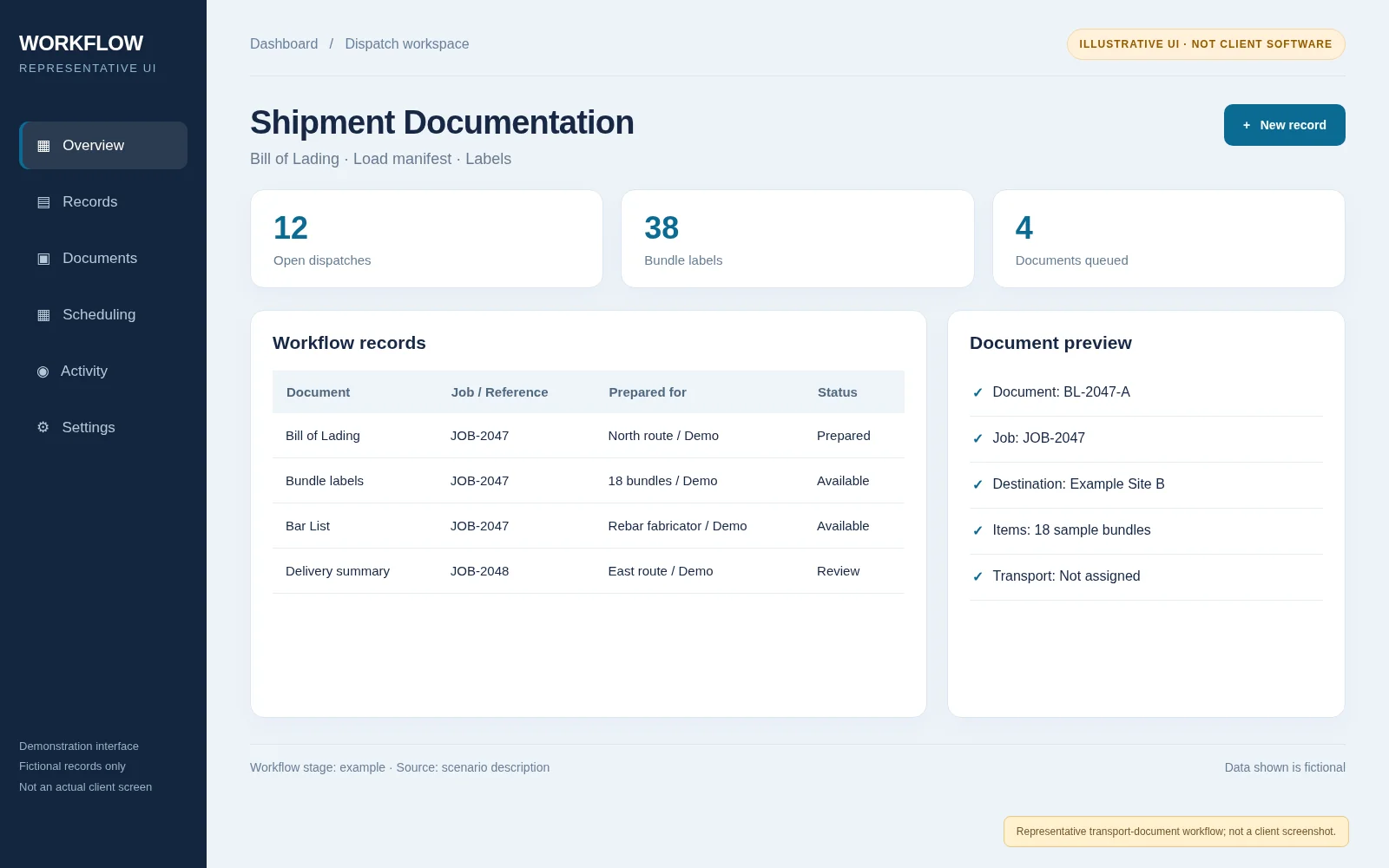
Illustrative screen: Job document and dispatch paperwork concept; fictional data; not a real client screenshot
Representative interface · illustrative (not actual client UI)Job-linked transport documentationIllustrative interface showing Bills of Lading, bundle labels and document records with fictional job information.
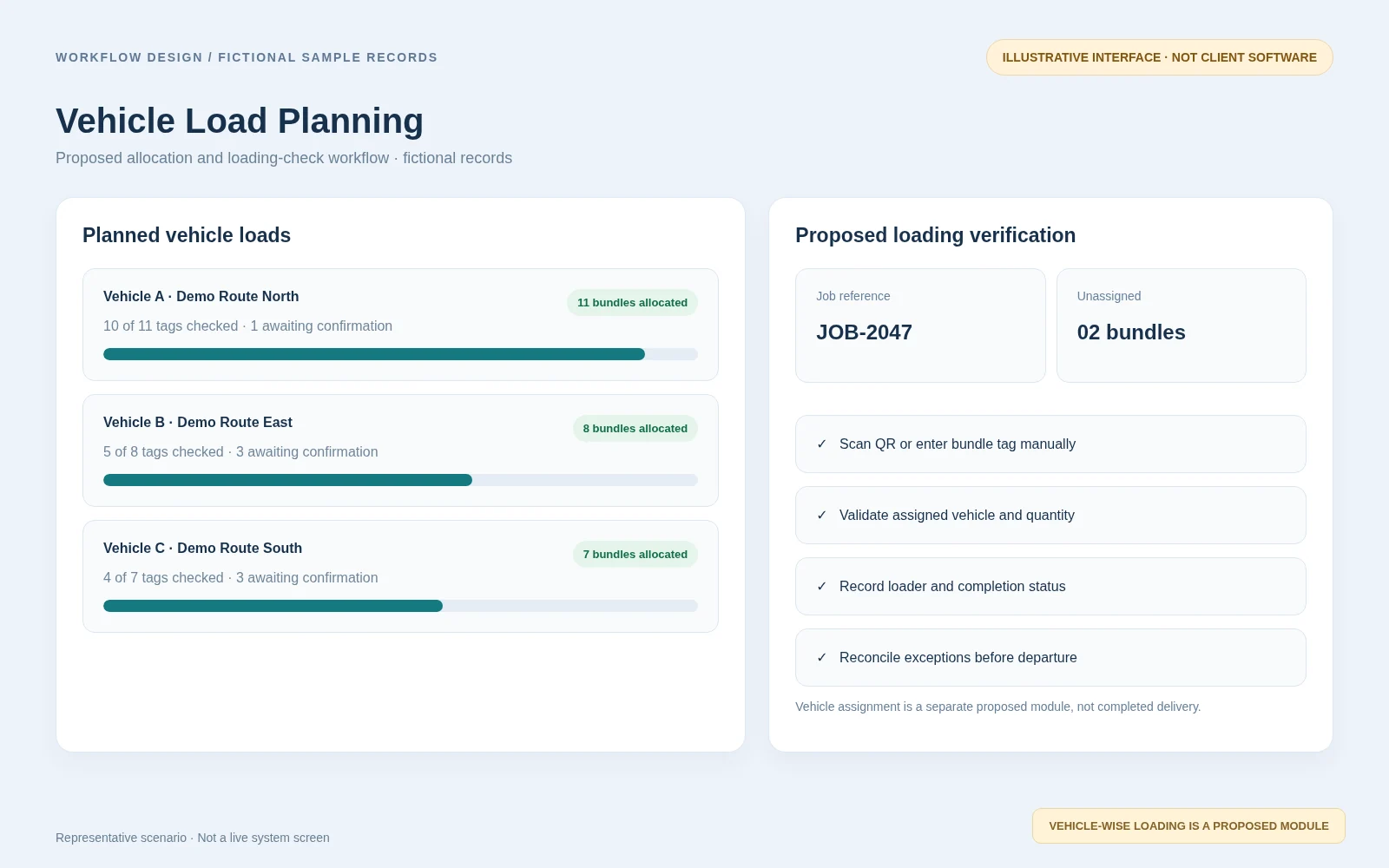
Illustrative screen: Vehicle allocation and loading checklist concept; fictional data; not a real client screenshot
Representative interface · illustrative (not actual client UI)Vehicle-wise bundle allocation planningIllustrative interface for a proposed vehicle loading module, with sample tags, vehicles and verification steps; not a delivered client screenshot.
Detailed project walkthrough

Explore the business context, two operational challenges and the source-labeled workflow visuals.

View Solution Scenario
Implementation approach

From discovery to a supported workflow

01

Understand the current workflow

Document how staff, customers and existing platforms exchange information.

02

Design the minimum useful system

Agree roles, data ownership, integrations and practical success criteria.

03

Implement and validate

Build in phases and test exception cases with example operating records.

04

Handover and support

Train users, document responsibilities and plan future improvements.

Questions we hear

Frequently asked questions

Can our existing system generate Bills of Lading and labels?

Where structured job and shipment data exists, custom document generation can reduce duplicate entry. The specific formats and approval steps must be reviewed.

Can one job be split between multiple vehicles?

A custom allocation module can model vehicle-wise loads and remaining materials; it requires agreed business rules for partial bundles and exceptions.

Is QR scanning mandatory for vehicle loading?

No. A loading workflow can support manual tag entry first, with QR-based verification where devices and processes justify it.

LET'S DISCUSS YOUR PROJECT

Logistics for Shipment and Fleet Workflows?

Tell us about your current process and the first issue you need to solve.