Industry solutions / Mobility Platforms

Custom Mobility Booking and Dispatch Software Development

Connect service requests, driver or vehicle availability, assignment decisions and customer status updates in one purpose-built workflow.

  • Organize ride or service booking requests with clear statuses
  • Match available operators and vehicles to assignments
  • Provide timely customer notifications and dispatch visibility

Concept diagram · Not a client system screenshot

Common operating bottlenecks

Two challenges worth solving first

Explore how a targeted solution could reduce friction in everyday operations.

01Booking and dispatch

Requests arrive faster than dispatchers can coordinate

Bookings may arrive by phone, website and partner channels, while operator availability is held in separate lists.

HOW WE APPROACH IT

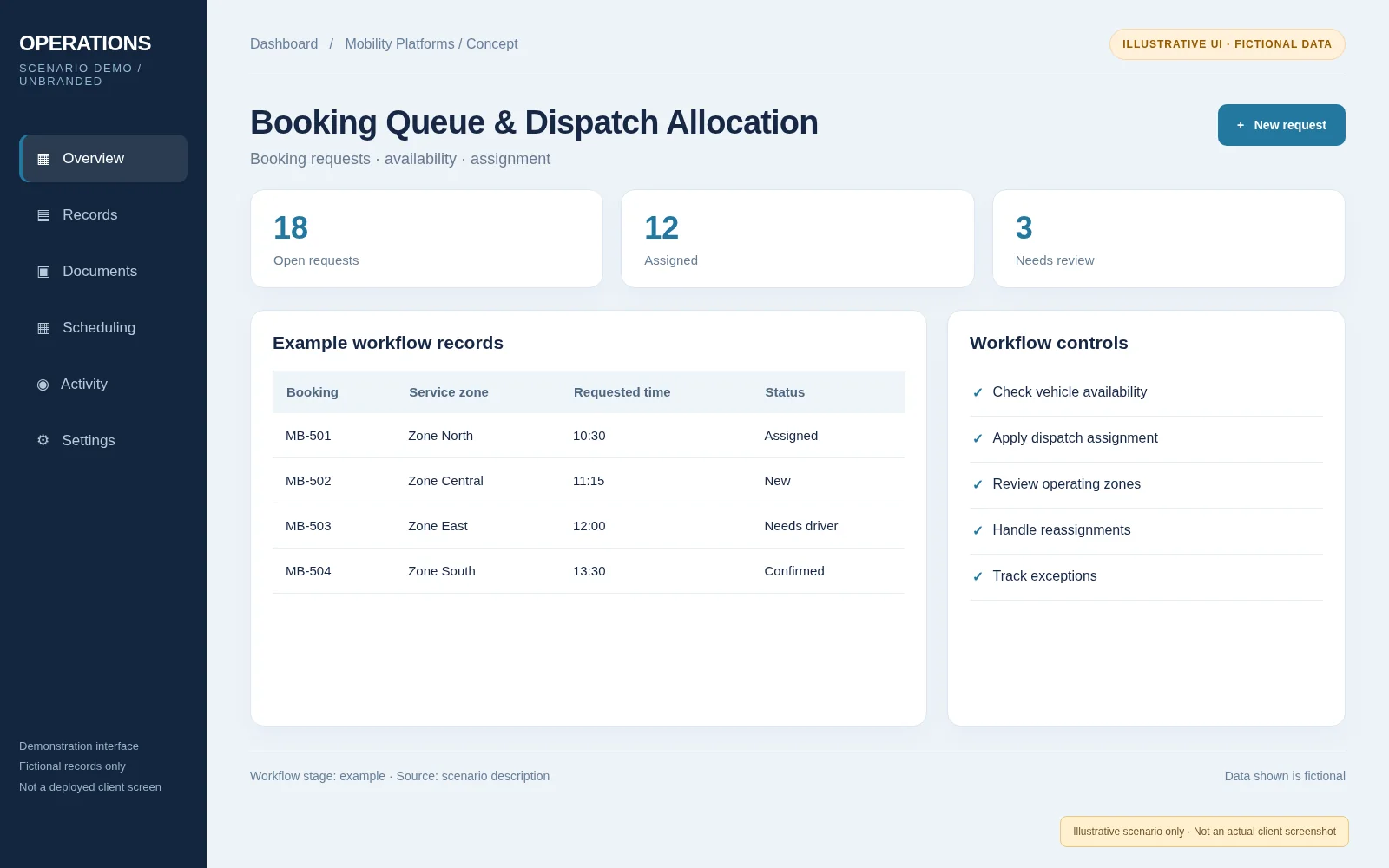
Build a central booking queue with availability checks, assignment controls and exception handling.

  • Booking and pickup details
  • Availability and assignment rules
  • Cancelled and reassigned status
Discuss this problem
02Status and communication

Customers have little visibility after allocation

Without a consistent service lifecycle, support teams cannot confidently answer whether a vehicle is assigned, on the way or completed.

HOW WE APPROACH IT

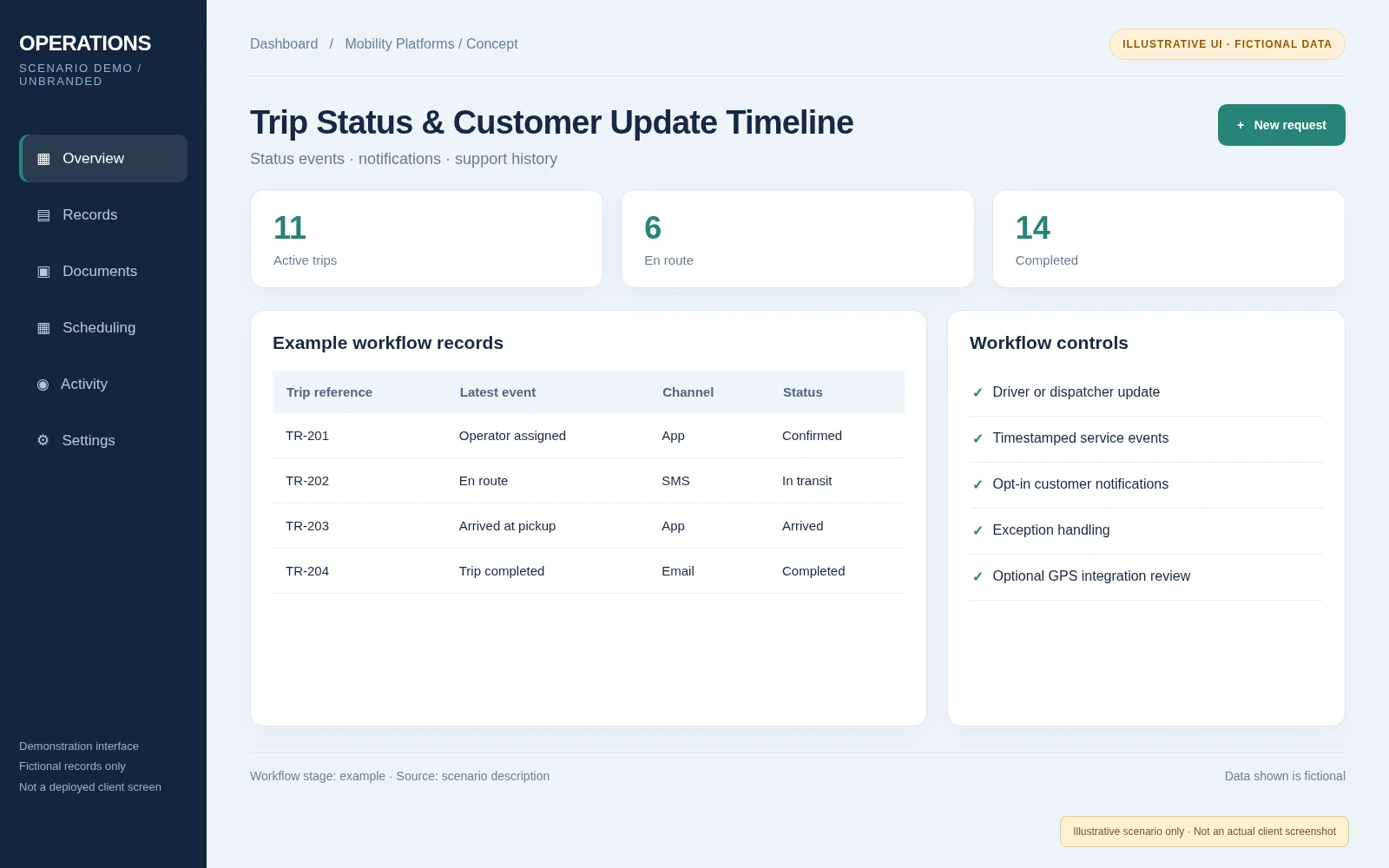
Design an event-driven status timeline and approved notifications; add GPS tracking only where properly integrated and consented.

  • Assignment to completion timeline
  • Customer notification events
  • Optional location integration by scope
Discuss this problem
Custom software possibilities

Practical features to fit your business

These are design capabilities, not claims of completed client deployments.

Booking and allocation

Capture service requests and assign qualified available operators.

Dispatch operations

Manage status changes, reassignment and exceptions.

Customer notifications

Send permission-aware booking and status updates.

Driver and customer interfaces

Plan mobile or web journeys appropriate to the operating model.

Illustrative solution scenario / Not a client delivery

Mobility Booking, Assignment and Trip-Status Workflow

A detailed proposed workflow based on common mobility platforms operational scenarios. The examples use fictional data and do not claim a completed client project.

Illustrative workflow
THE CHALLENGE

Maintain one shared view of reservations, allocation and status transitions.

TECHNICAL APPROACH

Define responsibilities and state transitions, connect existing records, handle exceptions and validate usability before extending the scope.

SOLUTION AREAS
  • Web and manual booking sources with validation
  • Vehicles, shifts, capacity, zones and time windows
  • Assignment, reassignment and exception transitions
  • Operator updates and optional location/notification integrations
Outcome & Business Impact
  • More visible booking queuesDispatchers can see requests awaiting an assignment decision.
  • Consistent assignment historyRecording transitions can clarify why a trip was assigned or reassigned.
  • Clearer customer updatesStandard status events can support timely notifications where enabled.
View all business benefits

Inside the workflow

Explore visuals related to the described workflow.

Illustrative screen: Booking Queue & Dispatch Allocation; fictional records; not real client software
Representative interface · illustrative (not actual client UI)Booking Queue & Dispatch AllocationRepresentative mobility platforms workflow UI with invented records. Not an actual client application screenshot.
Illustrative screen: Trip Status & Customer Update Timeline; fictional records; not real client software
Representative interface · illustrative (not actual client UI)Trip Status & Customer Update TimelineRepresentative mobility platforms workflow UI with invented records. Not an actual client application screenshot.
Detailed project walkthrough

Explore the business context, two operational challenges and the source-labeled workflow visuals.

View Solution Scenario
Our delivery approach

Assess, design, validate and support

01

Map your current process

Review current tools, staff roles, data and exception cases.

02

Agree the MVP scope

Choose measurable workflow improvements and confirm the data model.

03

Build and validate

Implement defined stages and test realistic sample cases with users.

04

Plan the next iteration

Document integrations, training and ongoing support requirements.

Common questions

Frequently asked questions

Can dispatching work without live vehicle GPS?

Yes. A status-based workflow can begin with dispatcher or driver updates. Real-time location is a separate integration with device, consent and accuracy requirements.

Can bookings come from multiple channels?

A central booking API can accept website and permitted partner requests, with manual entry for phone bookings.

How should cancellations and reassignments work?

The booking state model should define who can cancel, when charges or refunds apply, how reassignment is recorded and which notifications are sent.

LET'S DISCUSS YOUR PROJECT

What is your most costly workflow bottleneck?

Explain your current systems and the specific issue. We can evaluate the design and integration options.